



Maintaining a healthy garden or a productive crop does not depend only on the amount of water applied, but on how it is distributed. At that point, irrigation sprinklers play a fundamental role. A proper installation can improve irrigation uniformity, optimize water use, and promote a more balanced growth of the lawn or plants. However, not all systems work in the same way or respond the same under different pressure, surface, or soil conditions.
Within sprinkler irrigation, three main models stand out: emergent (pop-up) sprinklers, rotary sprinklers, and impact sprinklers. Each has specific technical characteristics, different ranges and distribution patterns that directly influence their performance. Understanding these differences helps determine which solution best fits residential gardens, large green areas, or agricultural surfaces.
What is an irrigation sprinkler and how does it work?
An irrigation sprinkler is a device designed to distribute water evenly in the form of artificial rain over a defined surface. It connects to a hydraulic network —domestic or agricultural— and transforms water pressure into a controlled spray pattern. The goal is to moisten the ground uniformly, imitating natural precipitation and promoting balanced absorption.
This system is frequently used in residential gardens, public green spaces, sports fields, and agricultural operations. Its popularity stems from its ability to cover large surfaces with relative ease, automate irrigation cycles, and improve efficiency compared with manual methods.
Differences between sprinkler irrigation, drip irrigation and manual watering
Although sprinkler irrigation is widespread, it is not the only method available. Drip irrigation, for example, delivers water directly at the base of the plant through emitters that supply small amounts continuously. This system reduces evaporation and is especially useful in specific crops or areas with water restrictions.
Manual watering, for its part, involves using hoses or sprinklers without a defined distribution pattern. Although it can be practical in small spaces, it tends to produce uneven distribution and higher consumption if not carefully controlled.
Sprinkling stands out for its capacity to cover large areas with a uniform distribution, making it a common option for lawns and large surfaces.
Types of irrigation sprinklers: overview
Within a sprinkler irrigation system there are different technologies designed to adapt to surfaces, pressures, and specific needs. Although all sprinklers fulfill the same basic function —distributing water as artificial rain— their internal mechanism, reach, and spray pattern vary significantly.
Knowing the main types of irrigation sprinklers helps understand their technical differences and practical applications before entering a more detailed comparison. The most commonly used models are grouped into three categories: emergent (pop-up) sprinklers, rotary or turbine sprinklers, and impact sprinklers.
Pop-up sprinklers
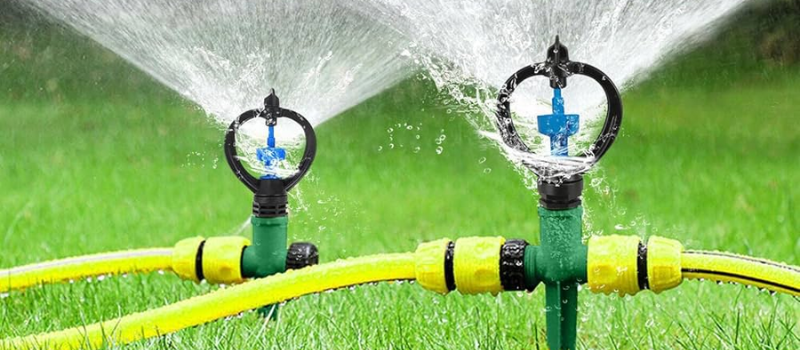
Pop-up sprinklers, also known as “pop-ups,” are installed below ground level and remain hidden when the system is inactive. When irrigation is activated, the water pressure lifts the sprinkler body, which begins to distribute water at the configured angle and reach. Once the cycle ends, the head retracts again.
This type of sprinkler is common in residential gardens and decorative green areas. Its main advantage is aesthetic integration, since it does not protrude above the ground when not in operation. Additionally, it allows uniform distribution in small to medium areas.
There are models with short, medium, and longer reach, as well as versions with adjustable nozzles that modify the spray arc. In general, they operate properly at moderate pressures and are compatible with automated systems via timers.
Rotary or turbine sprinklers
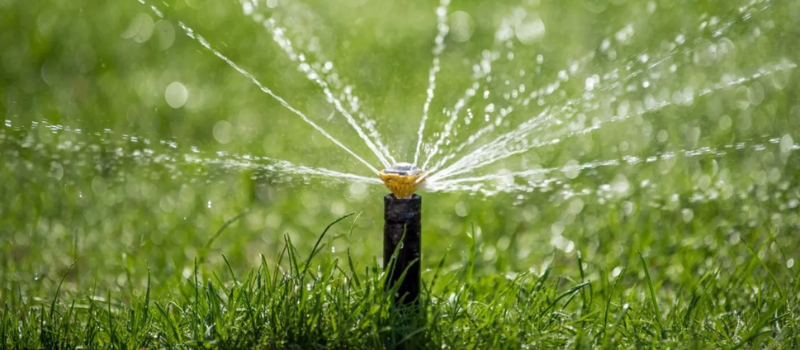
Rotary sprinklers, also called turbine sprinklers, incorporate an internal gear mechanism that spins one or more water jets in a controlled way. Unlike emergent sprinklers with fixed diffusion, these models project water in a concentrated jet that rotates slowly, allowing greater distances to be covered.
Their design favors more efficient water distribution, since the jet maintains greater consistency even in light wind conditions. For this reason, they are frequently used in medium and large gardens, sports fields, and expansive lawn surfaces.
Another relevant feature is their ability to adjust the working angle and reach radius. This facilitates more precise planning of the irrigation system and reduces excessive overlap. In general, they require medium pressure to operate correctly.
Aer sprinklers
There seems to be a naming mix-up in the original (likely “aspersores de impacto”). The intended section title is “Impact sprinklers.”
Impact sprinklers are recognized by their external mechanical mechanism that intermittently strikes the water jet, generating a progressively circular movement. This system, though traditional, stands out for its durability and ability to cover large surfaces.
They are common in agricultural environments, wide terrains and areas where high water pressure is available. Their structure is typically robust and designed to withstand continuous use and demanding conditions.
The reach of impact sprinklers can far exceed that of other models, making them an efficient option for irrigating large expanses. However, their installation and adjustment require more planning to avoid waste or irregular distribution.
Pop-up sprinklers: characteristics, advantages and disadvantages
Pop-up sprinklers have become one of the most widely used solutions in residential gardens thanks to their discreet design and integration with automated irrigation systems. This type of sprinkler remains hidden below ground level when not in operation, which helps maintain a clean and orderly aesthetic in green areas, ornamental lawns, and landscaped spaces.
Their compact design and ease of programming position them as an efficient option for those seeking uniform water distribution without affecting the garden’s appearance.
Main advantages
One of the main advantages of pop-up sprinklers is their discreteness. By not protruding when inactive, they maintain the visual harmony of the outdoor space, something particularly valued in residential gardens and decorative areas.
They also stand out for their compatibility with automated systems. They easily integrate with timers, rain sensors, and solenoid valves, which allows precise control of irrigation schedules and duration. This automation contributes to more efficient water management.
Another plus is uniformity on small and medium surfaces. When properly distributed, they provide even coverage that supports balanced lawn growth.
Limitations and disadvantages
Despite their benefits, pop-up sprinklers have certain limitations. Their reach is often smaller compared with rotary or impact models, making them unsuitable for large expanses.
Additionally, they require more careful underground installation. If the system is not properly leveled, water pooling or dry spots can occur. Regular maintenance is also important to prevent nozzle obstructions.
In areas with insufficient pressure, the riser may not rise fully, affecting the irrigation pattern.
Rotary sprinklers: efficiency and reach on medium to large surfaces
When it comes to covering broad lawns with a constant and controlled distribution, rotary sprinklers stand out for their balance between reach and water efficiency. This type of sprinkler is designed to operate on medium to large surfaces where fixed-diffusion models may fall short.
Their technology allows projecting water to greater distances without creating excessive spray. The result is more uniform irrigation, with less evaporation loss and better use of the available flow.
Operation of the rotary system
The rotary sprinkler, also known as a turbine sprinkler, incorporates an internal gear mechanism driven by water pressure. When the system is activated, the water drives a small turbine that slowly and steadily spins the head.
Unlike models that spray in a fixed fan, the rotary emits one or more defined jets that move progressively across the programmed area. This controlled movement allows covering specific angles — full or partial — according to the prior configuration.
Most of these sprinklers require medium or medium-high pressure to operate optimally. When pressure is adequate, the rotation remains stable and the reach is adjusted to the established parameters.
Advantages in water use and uniformity
One of the main advantages of rotary sprinklers is their efficiency in water use. By projecting more defined jets instead of fine mist, evaporation and wind drift are reduced. This improves soil infiltration and reduces waste.
They also offer more uniform distribution over large areas. The slow rotation helps each zone receive water in a balanced manner, especially when installed with an appropriate overlap pattern.
Another relevant aspect is their greater reach compared to emergent sprinklers with diffusion. This allows covering more area with fewer units, simplifying the irrigation system design.
Disadvantages to consider
Although they have several advantages, rotary sprinklers are not without limitations. Their performance heavily depends on stable pressure. If the flow rate is insufficient, the rotation can become irregular and affect uniformity.
Moreover, installation requires careful planning to ensure that the radii overlap correctly. Poor distribution can create dry or overly wet areas.
Compared to simpler models, their initial cost is usually higher, though this difference can be offset by long-term water savings.
Impact sprinklers: power and coverage over large expanses
When the goal is to irrigate large surfaces with high pressure and considerable reach, impact sprinklers stand out as a robust and effective solution. This type of sprinkler is widely used in agricultural environments, open fields, and areas where it is necessary to cover large areas with the fewest possible devices.
Their mechanical, visible, and robust design is meant to withstand demanding conditions, long operating hours, and flow variations. Therefore, it is often associated with professional rather than domestic use.
How impact sprinklers operate
The operation of impact sprinklers is based on an external mechanical mechanism that rhythmically interrupts the water jet. When water flows under pressure, it drives a hinged arm that strikes the flow intermittently. Each impact causes a small head displacement, generating a progressive circular motion.
This system allows covering a defined angle or performing a full 360-degree rotation, depending on the configured setting. The jet force directly depends on the available pressure; the higher the pressure, the greater the reach.
Unlike other models with internal gears, the impact mechanism is simpler and more visible, which facilitates maintenance in case of wear or residue buildup.
Advantages on large terrains and agricultural use
One of the main advantages of impact sprinklers is their ability to cover large expanses with a considerable reach. In agricultural operations or wide plots, this reduces the need for multiple irrigation points.
They also stand out for their durability. They are built, in many cases, with high-durability metallic or plastic materials that withstand harsh weather conditions, prolonged sun exposure, and continuous use.
Another important advantage is their compatibility with high-pressure systems. In areas where flow is abundant, this type of sprinkler takes advantage of that force to project water over long distances without losing consistency.
Disadvantages compared to other models
Despite their power, impact sprinklers present certain limitations. Their operation can yield less uniform distribution compared with turbine rotary sprinklers, especially on smaller surfaces.
Additionally, their visible structure may not be suitable in residential gardens where aesthetics are prioritized. The characteristic noise of the mechanism can also be a drawback in urban environments.
Another aspect to consider is water consumption. Due to their high flow, they can be less efficient if not properly adjusted to the actual needs of the terrain.
Direct comparison: emergent vs rotary vs impact
After analyzing each type separately, it's time to compare the three main sprinkler models head-to-head: emergent, rotary, and impact. This comparison allows clearly visualizing their technical differences and understanding which best fits certain surface, pressure, and usage conditions.
To improve understanding and facilitate reading, it is advisable to include a comparative table summarizing the key aspects. This not only improves the content's scan-ability but also helps with SEO by better structuring the information.
Reach and coverage
In terms of reach, impact sprinklers tend to lead the comparison. They are designed to cover large expanses and can reach greater distances when operating under high pressure.
Rotary sprinklers occupy a middle ground. They offer a wide and uniform radius, ideal for medium and large surfaces, especially on broad lawns.
Meanwhile, emergent sprinklers show a more limited reach. They work best in small to medium areas where precision and control of the irrigation angle are required.
Water consumption
Water consumption varies according to design and pressure used. Rotary sprinklers typically offer an efficient balance, as they project defined jets that reduce evaporation and improve infiltration.
Emergent sprinklers can be efficient in compact spaces, provided they are well distributed. However, as more units are needed to cover large areas, total consumption may increase.
Impact models, when operating with high flow, can consume more water if not properly regulated. They are powerful, but require careful planning to avoid waste.
Required pressure
The available pressure is a determining factor.
- Pop-up sprinklers operate correctly with moderate pressure.
- Rotary sprinklers require medium or medium-high pressure to maintain a stable rotation.
- Impact sprinklers require high pressure to reach their maximum performance.
If the installation does not guarantee adequate pressure, performance may be compromised.
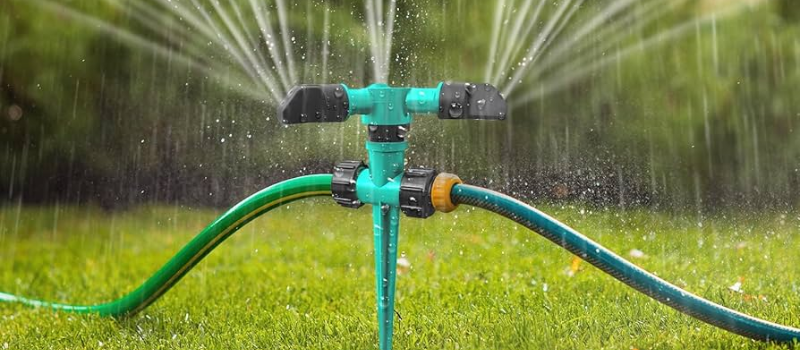
What sprinkler should you choose depending on your type of garden or terrain?
Each green space presents different conditions. Surface area, available pressure, type of vegetation, climate, and the irrigation system installed directly influence performance. If you're wondering which sprinkler to choose, how to choose an irrigation sprinkler, or what are the best irrigation sprinklers, the answer depends on the technical context and intended use.
Small and residential gardens
In smaller surfaces where the lawn coexists with pathways or decorative zones, precision is essential. Pop-up sprinklers and the diffuser sprinkler usually adapt better to this environment. Their retractable design maintains the garden’s aesthetics and fits well in an automatic irrigation system or smart garden irrigation setup.
A long reach is not required, but uniformity and angle control to avoid waterlogging. They are a good option among low-pressure sprinklers, ideal when flow is limited. They also fit in domestic landscaping projects where efficiency and discreteness are sought.
Medium lawn with automated system
When the area is larger and irrigation is zoned, the rotary sprinklers offer a better balance between coverage and consumption. Brands like Rain Bird or Hunter develop solutions with a wide range of sprinklers, adapted to medium pressure.
The slow rotation improves distribution and reduces evaporation. They are common in automatic irrigation installations, especially when comparing sprinkler brands and seeking efficiency on medium-sized lawns.
Large surfaces and agricultural lands
In extensive plots, the priority is reach and durability. The impact sprinklers respond well under high pressure and high flow. They are common in agriculture and professional systems where better sprinklers are needed to cover large radii.
Their robust structure supports heavy use and long rain irrigation sessions. In these scenarios, the technical analysis of the system —pressure, flow, and distribution— is key to ensuring performance and durability.
Conclusion: which model best fits each need
Sprinklers do not operate under a single scheme. Each type —emergent, rotary, or impact— responds to specific surface, pressure, and usage conditions. Understanding their technical differences allows optimizing water distribution, improving irrigation uniformity, and making better use of available resources.
In small residential gardens, emergent sprinklers offer discreteness, aesthetic integration, and good precision in confined spaces. In medium lawns or larger green areas, rotary sprinklers provide a solid balance between reach and water efficiency. Meanwhile, impact sprinklers stand out in large expanses and agricultural environments where power and durability are priorities.
The key is to analyze the land’s characteristics —pressure, flow, dimensions, and climatic conditions— before installing the system. Proper planning not only improves performance but also reduces waste and eases long-term maintenance.