





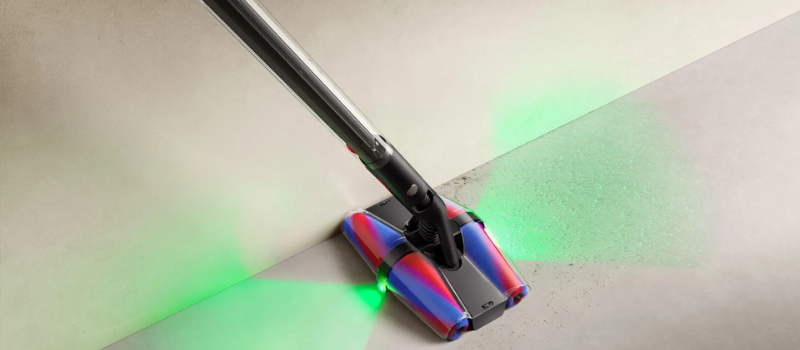
The Dyson PencilVac Fluffycones arrives with a proposal that breaks with the usual. Dyson has built its reputation on constant innovation, but this time the approach is especially striking: a radically minimalist design that promises to rethink how we understand household vacuuming. Less volume, fewer visible artifices, and an almost futuristic aesthetic. The question is inevitable: does that simplification translate into real increased efficiency?
In this in-depth analysis of the Dyson PencilVac Fluffycones we examine what lies behind its approach. It's not just about appearance. The reduction of traditional elements, the integration of the Fluffycones brushes, and the push for a more streamlined structure aim to optimize airflow, improve maneuverability, and facilitate daily use. But how does it perform on different floor types? Does it maintain the power expected from the brand? Does its minimalist approach compensate against more conventional models?
Throughout this article we review its technical features, autonomy, ergonomics, and performance in real-life situations. We also analyze whether this reinterpretation of the classic design provides practical advantages or if it mainly responds to an aesthetic strategy. Because when a vacuum changes its core concept, it doesn't just modify its form: it transforms the entire cleaning experience.
A proposal with clear advantages and defined limits
After the initial assembly steps, the experience with the Dyson PencilVac Fluffycones makes it clear that we are looking at a new Dyson vacuum with a very marked identity. Dyson bets on minimalism in this model, and it does so not only from the design but also from the functional approach. It has not developed a conventional vacuum, but a device with a very concrete focus: to simplify daily cleaning on hard floors through a lightweight format, digital assistance, and a head designed to minimize tangles of long hair.
When we talk about this new Dyson vacuum, we do so understanding that it does not seek to compete on every front, but to stand out in one specific area: frequent and practical cleaning in homes where hair and pets are part of everyday life.
Now, that same specialization implies clear strengths… and also limits that are worth keeping in mind.
Digital setup: real connectivity through the app
The setup process reflects that simplified philosophy. From the packaging, you are invited to download the MyDyson app via a QR code. The sequence is straightforward: scan, install, and follow instructions. After assembling the wand with the main body and attaching the grip where the battery integrates, the Bluetooth pairing is completed in a few minutes.
The app is not limited to showing battery. It allows you to check the filter status, receive maintenance alerts and access visual guides. This digital accompaniment adds real value to the user experience.
Lightweight and compact design: Dyson PencilVac analysis
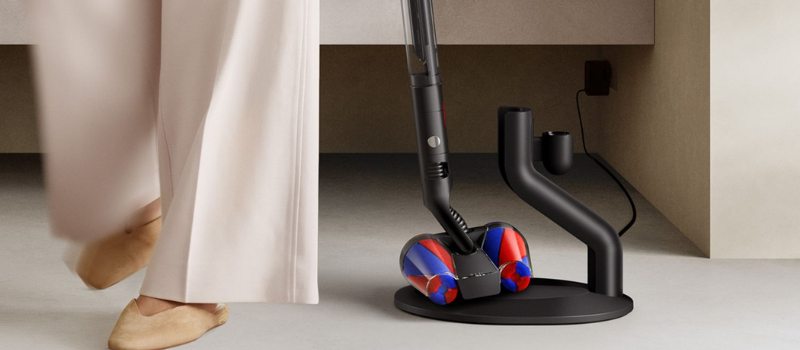
In this Dyson PencilVac analysis, one of the most evident aspects is its compact and lightweight format. With 1.8 kg, the feel in the hand confirms that this is a vacuum designed for quick and frequent sessions.
The balance of the unit facilitates natural movement on hard floors. It is not heavy or uncomfortable, something important when used several times a day.
Dyson also bets on minimalism in materials and finishes: proper plastics, solid assemblies, and a sober aesthetic oriented toward functionality.
Conical rollers and management of long hair
The major technical differentiator are its conical rollers. Instead of a single traditional brush, it incorporates four soft cones that move hair toward the ends, reducing tangles.
This system is especially relevant in homes with long hair. In traditional vacuum cleaners, hair tends to wrap around the central roller, forcing manual removal. Here the behavior is different: buildup decreases and cleaning becomes smoother.
It is not a magical solution, but it does improve one of the common weak points in many upright vacuum cleaners.
Suction power and autonomy
The suction power is distributed across three levels. Boost mode with accessories offers maximum performance, although it limits autonomy to about eleven minutes. Eco mode, on the other hand, allows reaching around 30 minutes in normal conditions.
This balance confirms its approach: frequent maintenance in small spaces, not long, deep cleans.
Full charge requires approximately 3.5 hours, a detail worth bearing in mind within its planned-use approach.
What this new Dyson vacuum is and what it is not
It is worth defining clearly. This Dyson vacuum is designed for dry cleaning on hard floors. It is compact, lightweight, and specialized in handling hair and fine dust.
It does not replace equipment designed for deep carpets, does not include mopping, and is not an autonomous robot.
Its performance depends on context. In homes where quick and constant cleaning is a priority, the proposal makes sense. Dyson bets on minimalism as a functional concept: reducing the unnecessary to focus on everyday efficiency.
Conclusion: Minimalism with practical meaning
After a thorough analysis of the Dyson PencilVac Fluffycones, my impression is clear: it does not try to do everything, and precisely there lies its strength. Dyson has chosen to refine a concrete idea—the frequent cleaning on hard floors, especially in environments where hair is a constant challenge—and has brought it to a light, manageable, and coherent format.
The combination of the Fluffycones head with green illumination provides real solutions to everyday problems. It is not just about aesthetic innovation; there is a tangible improvement in dealing with tangles and in the visibility of fine dust. Added to that is a well-integrated digital experience, which guides the user without imposing unnecessary complexity.
It is true that its maximum-mode autonomy is limited and that it does not replace equipment designed for deep cleans or demanding textile surfaces. But it does not intend to. Its focus is another: speed, comfort, and efficiency in daily maintenance.